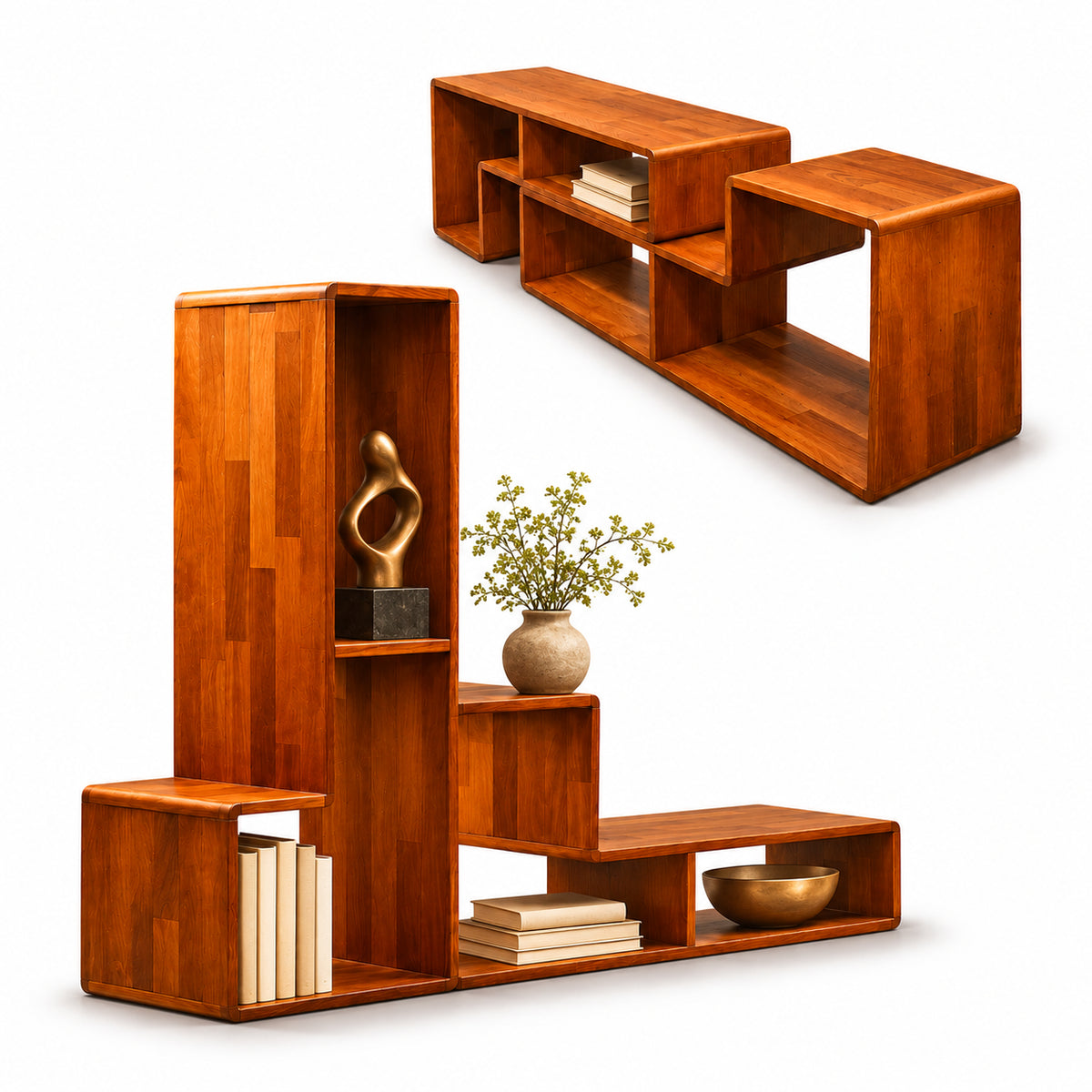
Brazilian Modern Transformable Modular Shelving System in Patchwork Freijó Wood, Brazil, 1970s — Lot 1262
Couldn't load pickup availability
Questions about this piece?
Description
An exceptional expression of Brazilian Modern design from the 1970s, this transformable modular shelving system in freijó wood challenges the conventional boundaries between furniture, architecture, and sculpture. Conceived around a remarkably inventive geometric composition, the piece offers multiple configurations, allowing its form, function, and visual identity to evolve according to the space it inhabits.
The design is defined by an extraordinary interplay of interlocking volumes, continuous wooden planes, gently rounded corners, and asymmetrical open compartments. The individual modules fit together in different orientations, creating an architectural composition in which positive and negative spaces are equally significant. Horizontal surfaces transition seamlessly into vertical planes, producing a compelling sense of movement and continuity throughout the structure.
Particularly distinctive is the use of Brazilian freijó wood assembled through a sophisticated patchwork technique. Individual sections of wood reveal subtle variations in grain, direction, and coloration, creating an intricate natural mosaic across the surfaces. Rich honey-caramel tones alternate with deeper amber and warm reddish-brown nuances, lending the piece remarkable visual depth. The satin finish enhances the natural beauty of the wood, revealing its organic character and understated luminosity.
The rounded edges soften the otherwise rigorous geometry, introducing an almost organic quality to the architectural composition. This delicate balance between structural precision and material warmth is one of the most compelling aspects of the design.
One piece, multiple architectural identities.
What makes this shelving system particularly exceptional is its transformative nature. Unlike conventional modular furniture, which typically relies on repetition, this composition allows the same elements to generate dramatically different silhouettes and spatial relationships.
Arranged horizontally, it becomes a generous low-profile bookcase, open credenza, media console, or sculptural entrance piece. Positioned vertically, the modules create a striking architectural display tower with a commanding sculptural presence. In an asymmetrical stepped configuration, the composition becomes an expressive shelving installation, combining vertical and horizontal volumes in a dynamic, almost architectural landscape.
Its open construction makes it particularly suitable for displaying collectible objects, bronze sculptures, studio ceramics, art books, and architectural models. Equally compelling when left entirely unadorned, the piece possesses sufficient visual strength to function as an independent work of sculptural furniture.
The design reflects the experimental spirit of Brazilian Modernism during the 1970s, a period in which furniture increasingly explored modularity, geometric abstraction, spatial flexibility, and unconventional approaches to traditional woodworking. Rather than treating furniture as a static object with a predetermined function, designs such as this embraced adaptability and encouraged a more personal relationship between the owner, the object, and its architectural surroundings.
Remarkably versatile, the shelving system feels equally at home in a contemporary Manhattan penthouse, a sophisticated private library, a Parisian residence, a modernist architectural home, or a collector's executive office. Its warm materiality complements both minimalist contemporary interiors and more historically layered environments.
Beyond its practical applications, this piece represents a particularly compelling intersection of Brazilian craftsmanship, geometric experimentation, and functional sculpture. Its ability to transform without losing its distinctive design identity makes it an extraordinary example of furniture conceived not simply to occupy space, but to actively redefine it.
Dimensions — Horizontal Configuration: 28” H × 72” W × 38” D